Can Hospitals Survive Without Air-Conditioning?
What started as a search on carbon footprint unexpectedly led me into the world of healthcare sustainability. It wasn’t a topic I had previously associated with climate action.
Healthcare exists to protect human health.
Yet few people realise the sector itself contributes approximately 4.4% of global greenhouse gas emissions. If healthcare were a country, it would rank as the world's fifth-largest emitter.
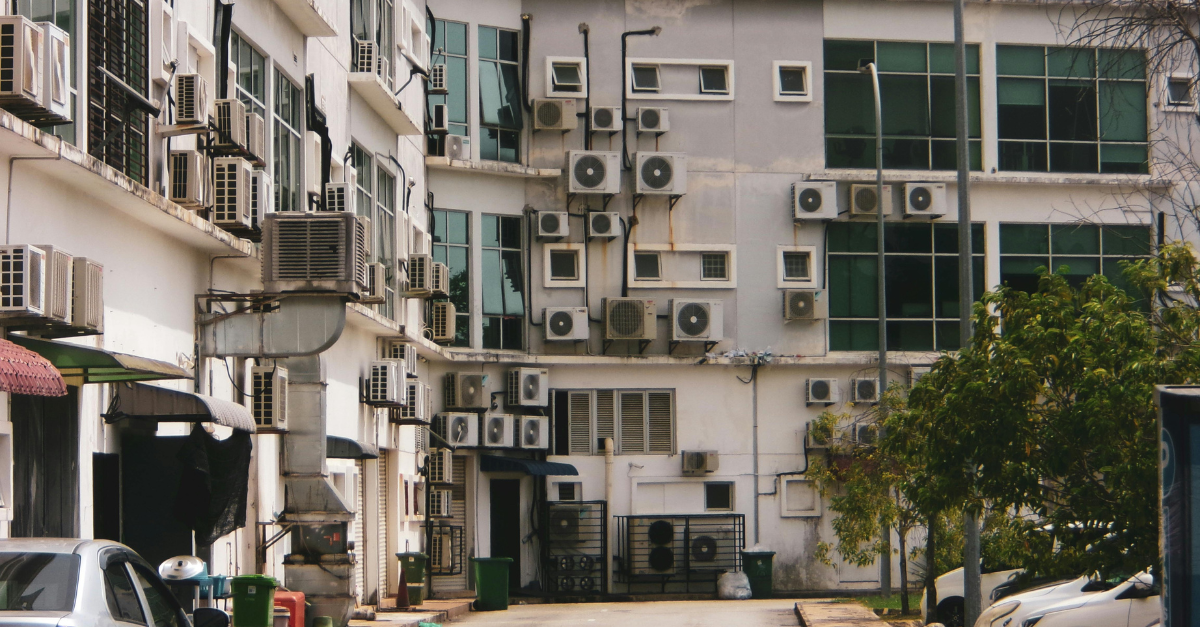
Even more surprising is that hospital cooling alone is currently around 365 MtCO₂e annually and could quadruple by 2040. That’s equivalent to emissions from 75+ million cars and 110 coal power plants.
So where do these emissions actually come from?
Healthcare’s climate footprint can broadly be divided into three categories: direct emissions from healthcare facilities, indirect emissions from purchased electricity, and emissions embedded throughout the supply chain.

While supply-chain emissions account for the largest share of healthcare's climate footprint, energy consumption within healthcare facilities remains a significant area where organisations can take immediate action.
One example is Yonsei University Health System in South Korea, which reduced energy costs by more than USD$1.7 million annually through a combination of energy-saving technologies. These included replacing ageing air-conditioning systems with more efficient equipment, improving refrigeration efficiency, incorporating ice-storage cooling systems, and installing a building energy management system to optimise heating and cooling performance.
These examples demonstrate how sustainability initiatives can simultaneously reduce emissions and operational costs.
Across Asia, healthcare organisations are increasingly exploring ways to reduce their environmental footprint. China has introduced regulations and plans to improve energy conservation across public institutions, including healthcare facilities. In India, the Chhattisgarh State Renewable Energy Development Agency (CREDA) and State Health Department have partnered to install and maintain solar PV systems across 900 health centres and district hospitals. Meanwhile, Kirtipur Hospital and Tilganga Institute of Ophthalmology in Nepal have committed to operating on 100% renewable electricity, helping reduce emissions while improving energy resilience in areas prone to power disruptions.
Close to home, Singapore offers several interesting examples. Khoo Teck Puat Hospital installed solar panels on the rooftops of both the hospital and the adjacent Yishun Community Hospital. These panels generate 456 MWh of clean energy annually, resulting in a reduction of 1824.2 tonnes of carbon emissions each year.
Beyond renewable energy, Singapore’s public healthcare has also implemented operational measures to improve efficiency. Under GreenGov.SG, public hospitals have adopted measures such as maintaining indoor temperature at 25°C, reducing the number of lifts in operation during non-peak hours, and using energy-efficient appliances, including lighting and air-conditioning systems.
Yet cooling systems are only one part of the story. Some emissions originate from sources many people would never expect.
One lesser-known source of healthcare emissions comes from anesthetic gases used during surgical procedures. Nitrous oxide and fluorinated anesthetic gases such as sevoflurane, isoflurane, and desflurane are among the commonly used ones. Research by the NHS Sustainable Development Unit demonstrates that the United Kingdom’s anesthetic gas footprint is 1.7% and the majority can be attributed to nitrous oxide use.

Another example is that Albert Einstein Hospital in Sao Paulo, Brazil found that GHG emissions from nitrous oxide contributed to 75% of their Scope 1 GHG emissions. The United States, United Kingdom, and Canada found that preferential use of desflurane resulted in a ten-fold higher quantity of anesthetic-related GHG emissions across hospitals in the study.
As healthcare demand continues to grow across Asia, the challenge may not simply be how to treat more patients, but how to do so while reducing the environmental footprint of the systems designed to keep people healthy. The examples from South Korea, China, India, Nepal, Singapore, and even Brazil show that sustainability is no longer a future aspiration. In many cases, it has already become part of how healthcare organisations manage energy, costs, resilience, and long-term patient care. Perhaps one of the biggest lessons is that climate action in healthcare isn’t only about breakthrough medical innovations, but also about the everyday operational decisions quietly taking place behind the scenes.