ASEAN Is Building More Solar. But Can It Operate It Intelligently at Scale?
How do operators efficiently manage and maintain increasingly massive renewable infrastructure systems?
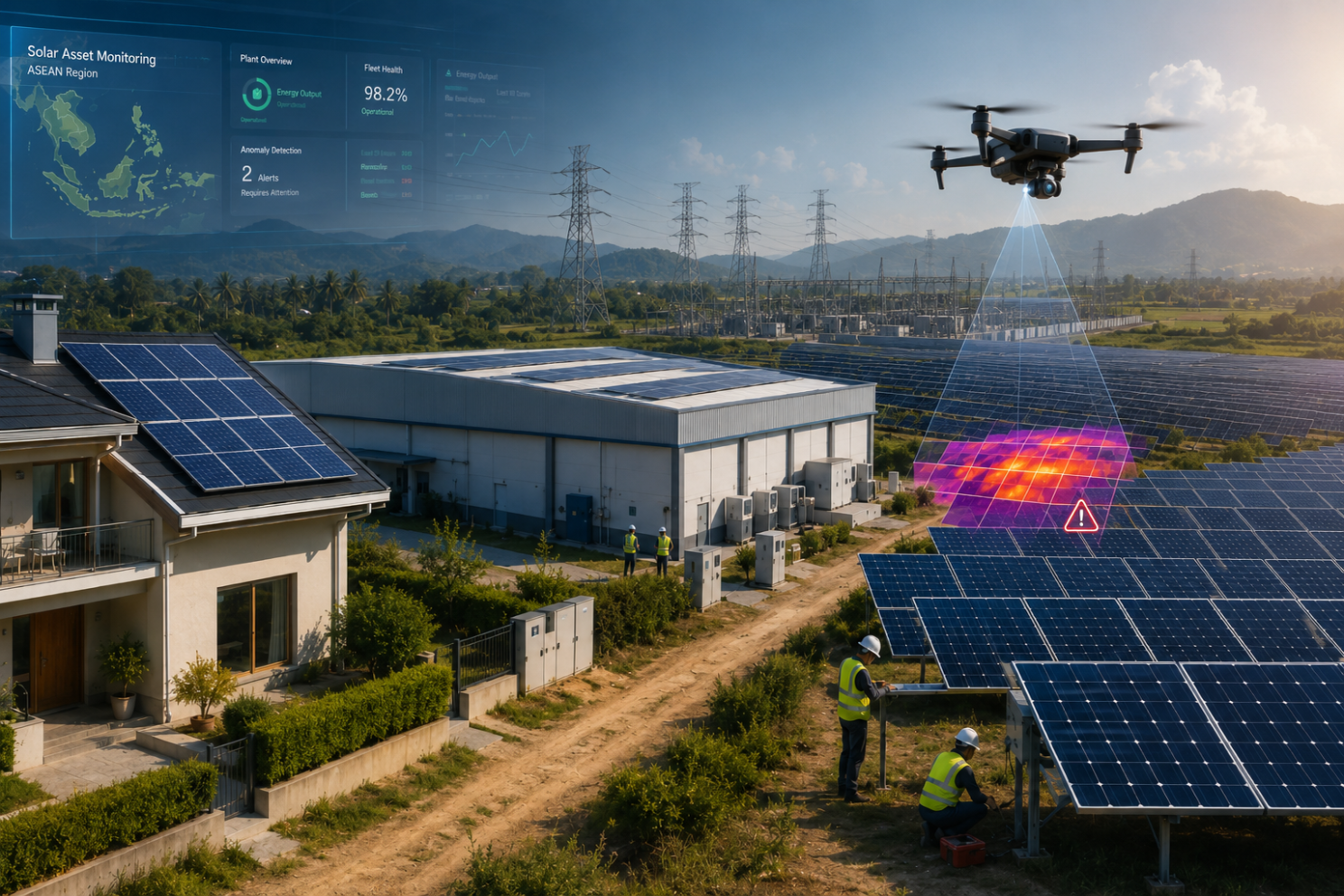
As geopolitical uncertainty, rising energy costs, and large-scale solar investments reshape ASEAN's energy landscape, governments and businesses are accelerating renewable energy adoption. In Malaysia alone, initiatives ranging from the SuRIA residential rooftop solar programme to large-scale solar projects in Kedah and Sarawak reflect the country's growing commitment to renewable energy.
Yet as solar capacity grows, a new challenge is emerging. Ensuring that these assets can be monitored and maintained efficiently over their lifecycle is becoming just as important as installing them.
One Malaysian startup helping answer that question is Airlytic, a company that combines drones, geospatial technology, AI, and digital twin modelling to help solar asset owners design, inspect, monitor, and maintain renewable energy infrastructure more efficiently.
What gives How Yong Guan optimism is the rapid pace of solar deployment across Southeast Asia. ASEAN's installed solar capacity has grown significantly over the past few years, signalling that the region is moving beyond early adoption into large-scale deployment.
Yet Yong Guan believes the next challenge is not simply installing more solar panels.
"The future of solar isn't just about generating more energy. It's about designing, operating, and maintaining solar assets more intelligently."
By transforming aerial data into actionable insights, Airlytic enables developers and operators to make faster decisions throughout the lifecycle of a solar asset, from site planning and system design to inspections and predictive maintenance.
As solar projects scale, developers face challenges long before a solar plant begins generating electricity. Accurate site measurements, terrain analysis, shading assessments, and system design are critical for ensuring project viability and maximizing energy yield.
Traditionally, these processes require multiple site visits, manual measurements, and fragmented software tools. Today, technologies such as drone-based 3D mapping and digital twin modelling are enabling developers to capture highly accurate site data, simulate solar performance, and optimize system designs before construction even begins.
The challenges don't end at construction. Once operational, asset managers grapple with visibility gaps, maintenance inefficiencies, and hidden performance drops. This is driving a massive wave of innovation in AI-powered monitoring, automated drone inspections, and predictive maintenance platforms that seamlessly connect the entire solar lifecycle.
As ASEAN continues scaling renewable energy deployment, the industry is increasingly recognizing the need for a digital intelligence layer that helps solar projects become more efficient, reliable, and financially sustainable.
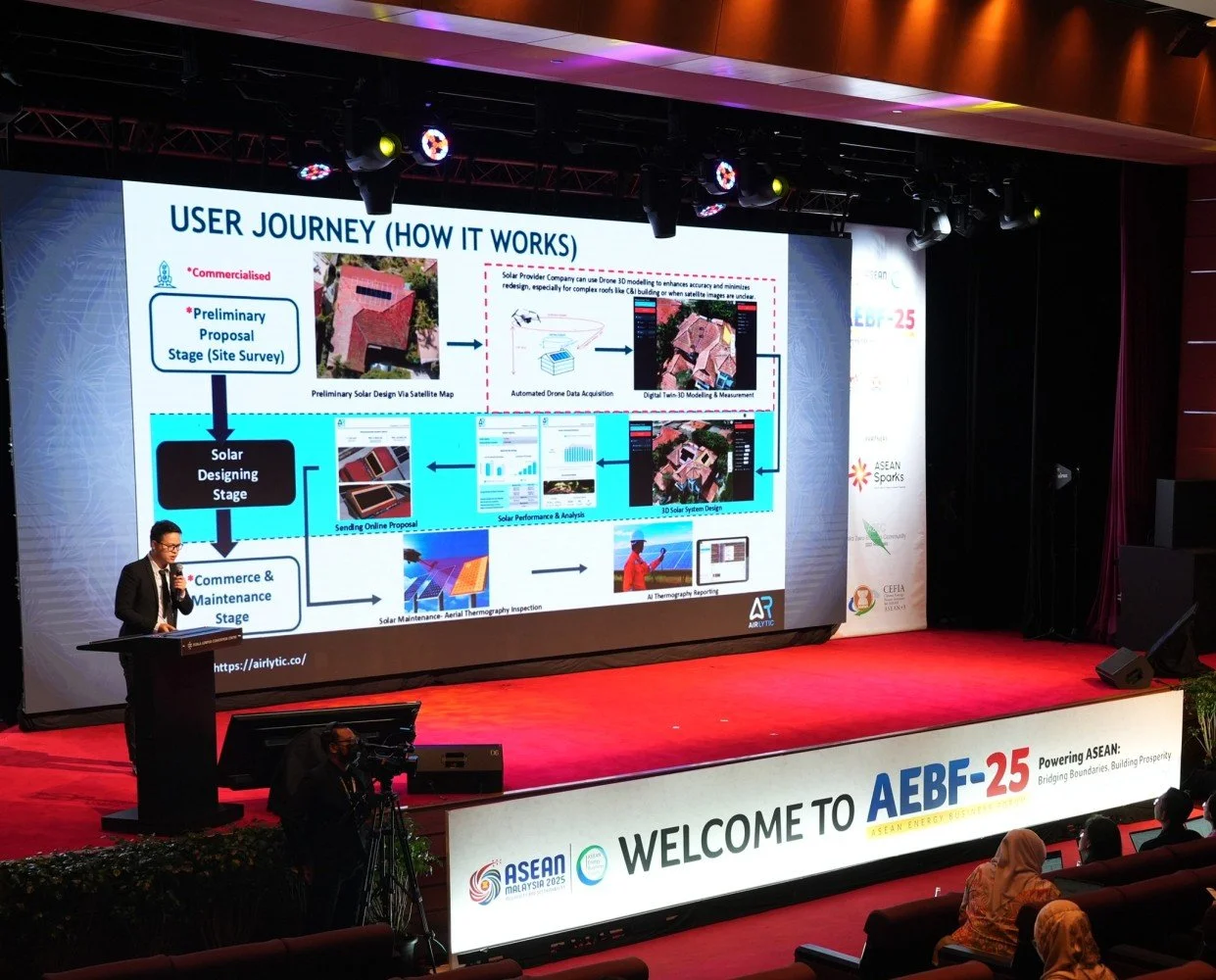
Traditionally, solar projects involve separate workflows for site surveys, engineering design, construction, inspections, and maintenance. As a result, valuable project data is often scattered across multiple teams and software systems.
“Drones were commonly being used just to capture photos and videos, but I saw a much larger opportunity. I believed drones could become intelligent tools for collecting highly accurate data, helping businesses gain a complete aerial perspective of their assets and make faster, smarter decisions. I wanted to move drones from being flying cameras to becoming data-driven solutions that create real operational value,” shared Yong Guan.
This vision eventually led to the development of Airlytic's Aerial Intelligence Solution.
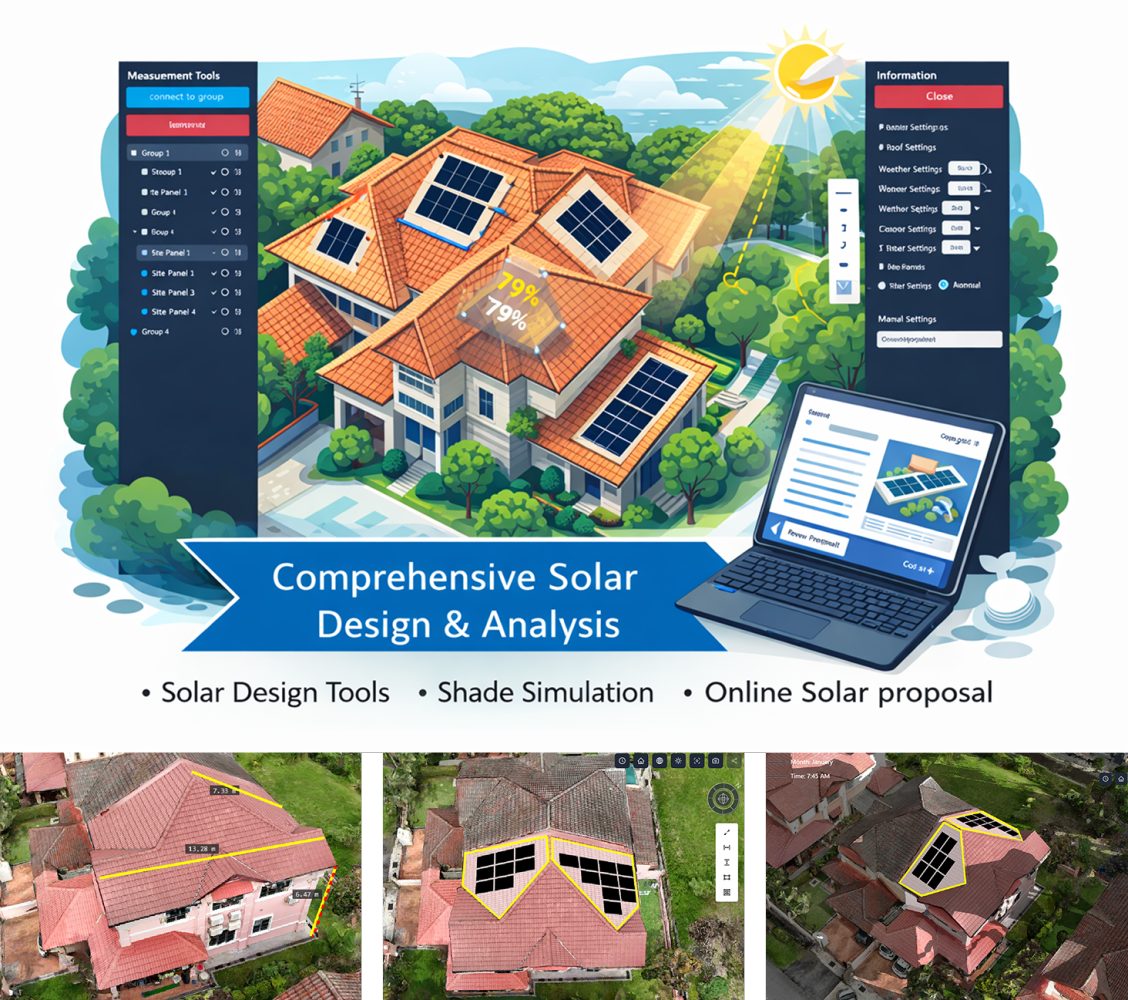
Airlytic leverages drones, geospatial technology, AI, and digital twin capabilities to support the entire solar asset lifecycle. During the development phase, drone-generated 3D models and digital twins enable engineers to automate site surveys, perform accurate rooftop measurements, conduct shading analysis, and optimize solar panel layouts with greater speed and precision.
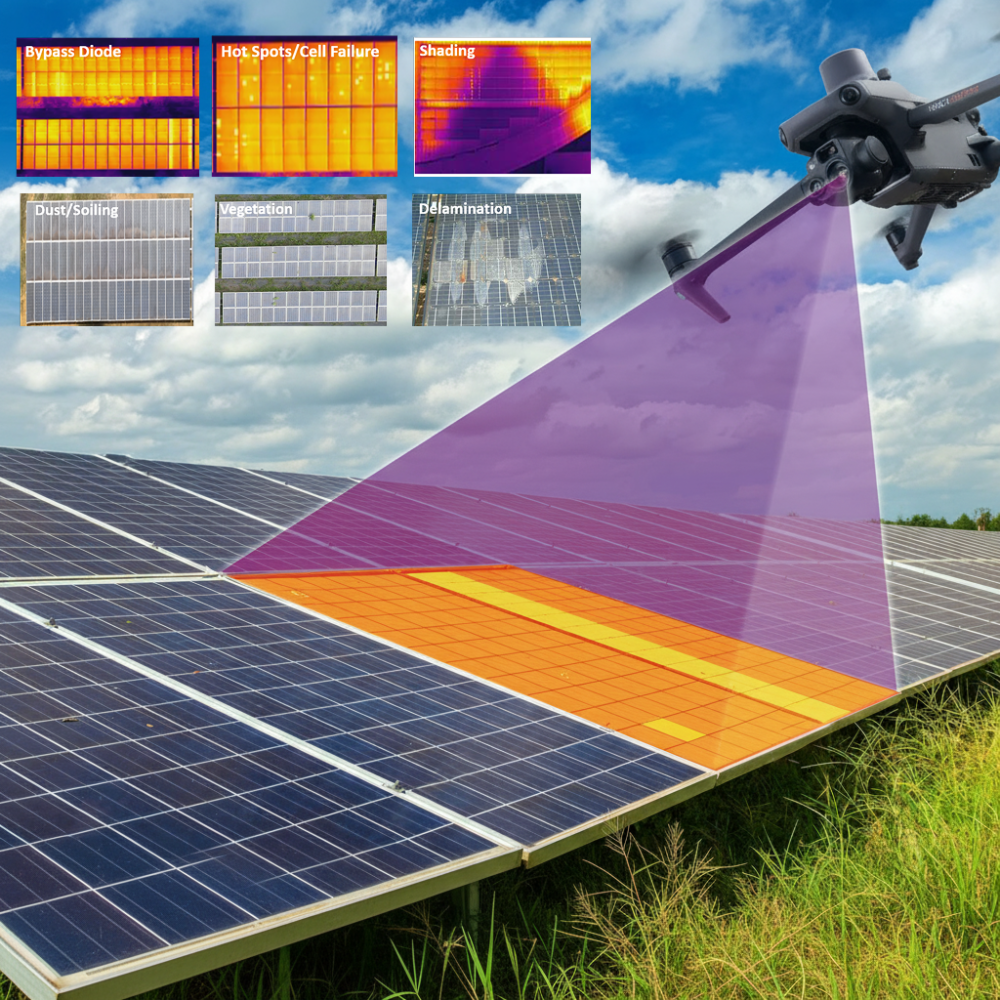
Upon achieving Commercial Operation Date (COD), the Airlytic team can perform autonomous aerial thermography inspections of solar assets, leveraging AI-driven analytics to detect defects, support predictive maintenance planning, and monitor overall system performance.
What previously required days of manual fieldwork can now be completed in hours, providing developers and operators with faster insights and more accurate decision-making throughout the lifespan of a solar asset.
"Many people assume solar panels are a set-it-and-forget-it asset," shared Yong Guan.
One of the most common misconceptions in the solar industry is that once a system is installed, it will continue performing optimally without much attention. In reality, small defects can develop quietly and remain undetected for months or even years.
For solar asset owners, even small efficiency losses across thousands of panels can translate into substantial revenue leakage over time, making early defect detection financially critical.
Yong Guan began to see the commercial value when he looked at the financial impact of hidden solar defects. Even minor faults within a panel can gradually reduce energy output, leading to significant revenue loss over time.
Traditionally, inspecting large solar farms required teams to manually walk through sites with handheld thermal cameras, checking panels one by one. This process was slow, labor-intensive, and sometimes unsafe. While conventional solar monitoring systems could indicate underperformance at an inverter or string level, they often failed to pinpoint the exact source of the issue at panel level.
Hence, Airlytic was created to bridge that gap by providing precise aerial inspections that can identify problem locations across an entire solar farm within hours. By using aerial thermography, operators can uncover hidden issues quickly and recover measurable value. It became clear that Airlytic was solving a real business problem.
Beyond that, some issues are visible, while others can remain hidden for months. These may include faulty bypass diodes, accumulated dirt, vegetation growth, shading, micro-cracks, or internal panel defects. Left unresolved, such issues can gradually reduce energy output, accelerate asset degradation, and impact long-term system reliability.
This is where aerial thermography and data-driven inspections become increasingly valuable, helping operators identify problems early before they develop into larger performance or maintenance issues.
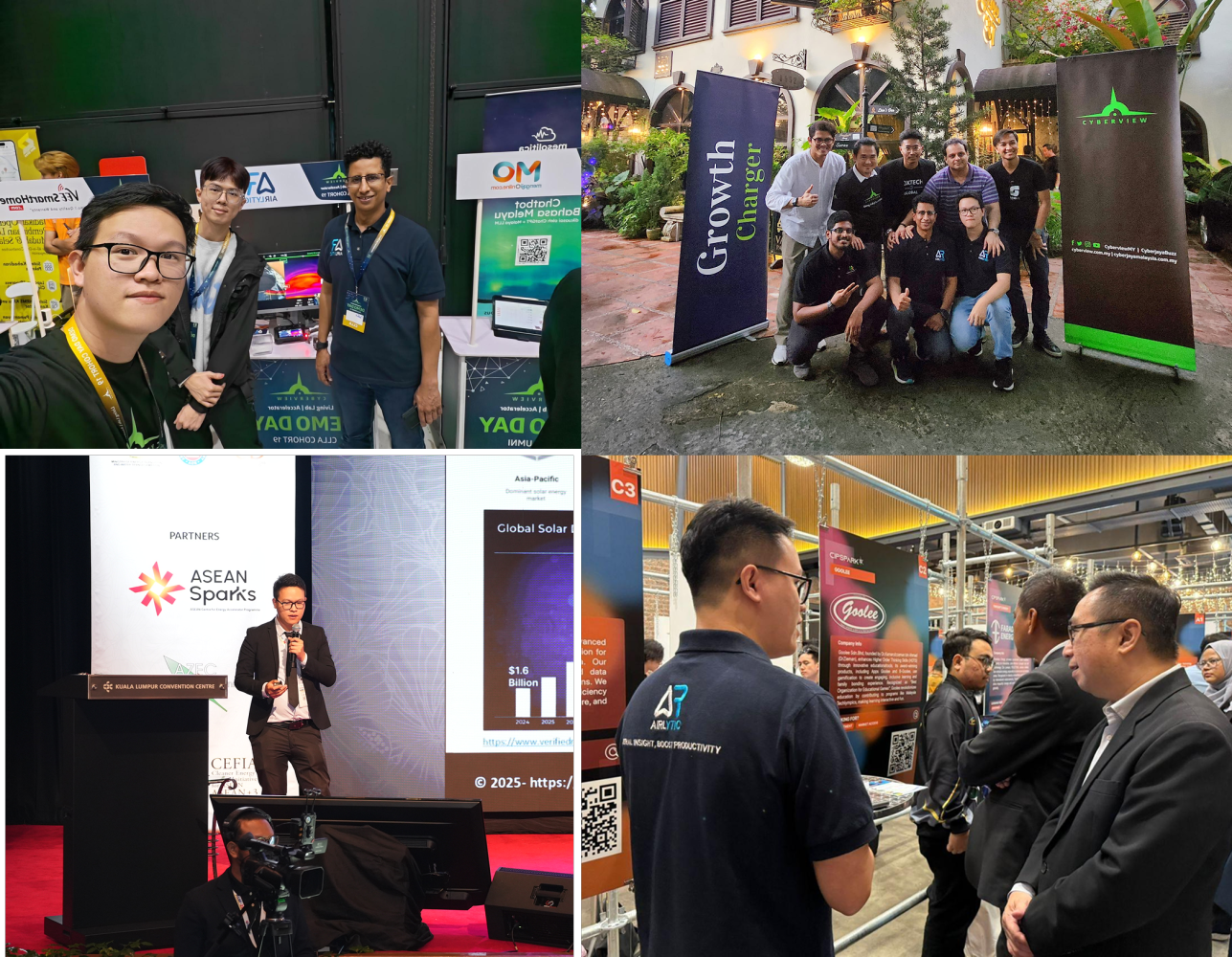
One of the biggest challenges in building a deep-tech company in Malaysia is that it requires significant investment in research and development before a product reaches commercial maturity. This often requires longer timelines and greater capital compared to traditional software businesses. There is also a challenge in finding and developing talent with interdisciplinary expertise, particularly individuals who understand AI, geospatial technologies, and drone systems together.
Despite these challenges, Yong Guan and his team have successfully launched their solution and gained early market traction in Malaysia. The longer-term vision goes beyond detection and monitoring, toward systems that can predict and prevent issues autonomously.
In the future, this includes fully autonomous drones operating from smart docking stations across solar farms. These drones will be capable of self-deployment, real-time site inspection, on-the-edge analysis, and the instant generation of maintenance actions with minimal human intervention.
Yong Guan believes at the core of this vision is a shift from reactive to predictive maintenance. Instead of identifying failures after they occur, AI systems will continuously analyse drone imagery, operational data, and environmental conditions to detect early warning signals. Rather than saying, "This panel has failed," future systems will be able to predict, "This component is likely to fail within the next two weeks. Schedule maintenance accordingly."
ASEAN's renewable energy transition is no longer just a construction challenge. Increasingly, it is becoming an intelligence challenge. The question is no longer how quickly solar assets can be deployed, but how intelligently they can be operated, maintained, and optimised over their lifetime.